
Strong Evidence for 8 Jungian Functions
By Dario Nardi, PhD, with thanks to Dr. Mina Barimany · July 2021, Updated July 2026
When asked about the validity of type, people often think of the MBTI® instrument. But what about the underlying Jungian framework that inspired Myers and Briggs? Are there really eight “functions”? And do they really stack in some kind of hierarchy? We can make some inferences based on dichotomous preference scores. But that’s not the same as an assessment that is specifically designed around Jung’s ideas. Fortunately, such as assessment exists, and recent rigorous statistical analysis of 129,350 persons reveals a treasure trove of results of positive results.
Overview
Between 2007 and today (2026), several hundred thousand people have taken, at no charge, the CPA (Cognitive Processes Assessment) found here on this site, at www.keys2cognition.com/assessment.html . The project began in 2007 and continues to this day in an effort to help people profile their use of the Jungian cognitive processes (aka mental functions, or psychological types). In 2018, Dr. Mina Barimany took up the mantle of analyzing the data and readying it for peer-reviewed publication in a widely-scoped journal.
What is the story, what has Mina discovered, and what are the implications?
The CPA questionnaire makes very few assumptions. It does assume eight cognitive processes as proposed originally by C. G. Jung. But that’s it. There are 48 statements, and the user rates each statement on its own merit along a Likert scale from “Not me” to “Exactly me”. This design is important. Unlike the MBTI® and most other type instruments, the CPA makes no assumptions about opposites, energy, consciousness, or such. Thus, analysis has allowed us to see how the processes stack up without leaning on a theory. In fact, even if it had turned out there were only, say, 4 functions, we could easily admit that too from the analysis.
Jung's Theory
What are the eight processes? As you likely know, Jung observed four mental functions (Sensing, Intuiting, Thinking, Feeling) with each showing up in either an extraverted or introverted attitude. For example, there is introverted Thinking (Ti), extraverted Thinking (Te), introverted Sensing (Se), and so forth for eight processes total. As you probably also know, Jung distinguished processes as either “rational” or “judging” (Thinking or Feeling) or as “irrational” or “perceiving” (Sensing or Intuiting) in nature. As suggested by the use of verbs as names here, the processes reflect psychological activities—akin to information processing—rather than outward behavior or static traits.
There are three more key points. First, Jung described “concrete” (aka basic or passive) versus “abstract” (aka advanced or active) usage of each function. Second, regarding how we manifest these, he proposed that each person has one process as dominant, and perhaps an auxiliary that is “different in every way” to complement it. And what about the other processes? Third, there is a developmental pattern. The other functions remain largely undeveloped and often used in only a basic way, if attended to at all. It is from their lack of incorporation into one’s psychical life that one-sidedness results, leading to neuroses.
Design Details
It is mostly from these observations, and more, that Myers and Briggs arrived at 16 types.
Now let’s dig into the CPA questionnaire. It consists of 48 statements and a respondent is invited to rate each statement on that 5-point scale. The statements can also be divided into three categories, like so:
- 16 statements offer a typical example of basic/passive use of a processes
- 16 statements offer a typical example of advanced/active use of a process
- 16 statements offer a blend of two processes, one judging and one perceiving, used synergistically in an advanced way.
Here, “basic” means more simple and passive use, whereas “advanced” means more complex and active use. For example, a basic extraverted Thinking statement reads, “Determine success by measurement or other objective method such as the time taken.” With some schooling and prodding, pretty much anyone can do this. In contrast, an advanced statement reads, “Construct an argument to convince someone using evidence clearly in front of you both.” This advanced activity is multi-faceted and requires expertise for success.
My hypothesis was that basic use is available to everyone whereas advanced use is typical of people who prefer that process. I offered basic statements in the CPA to let respondents express themselves while feeling okay to give lower ratings on advanced statements that are not in their wheelhouse. Of course, these questions are examples of typical use and not the underlying psychological process itself.
Starting in 2007, the questionnaire was available to everyone on the Internet for free with a carefully crafted and pithy set of instructions, plus some demographic questions. Then I mostly forgot about the CPA and let a mass of data accumulate as I turned to other projects.
Analysis/Methods
Over a decade later, Mina Barimany, Ph.D., of Johns Hopkins University asked me where all the data was. Good question! So much time had passed, I had to hunt around for it. Finally, I gave her access, and she conducted a study.
Specifically, Mina investigated large-scale patterns in the profile of preferences as reported by the assessment. For example, how might extraverted Sensing (Se) vary with extraverted Intuiting (Ne)? In theory, they are quite different: when one is high, we expect the other to be low. Or, when Se is strongest, is it complemented by introverted Feeling (Fi) or introverted Thinking (Ti) as theory asserts? Or instead, might it pair with another extraverted function, which is a less common but a possible way to read Jung? Basically, Mina’s study explored the orientation of the functions and attitudes relative to one another and their position in a hierarchy.
The study wasn’t just to validate (or adjust) Jung’s theory. Hopefully, analysis would give us insight into how the functions develop. Mina had the entire body of raw data (several hundred thousand entries!) to analyze. The extraordinary number of responses, gleaned over a decade, and the open-ended design—with independently rated statements—really provided a rich data set to clarify what’s what.
Mina did not use all of the data for her analysis. Rather, she included only the unique entries of persons ages 25 to 65, hailing from major web domains, and drawn from the 32 statements for basic and advanced use. The blended questions were excluded in order to greatly simplify analysis and, very importantly, to reflect that no assumptions were made or limitations placed regarding which functions might go with, oppose, or otherwise relate to each other.
Here are some technicalities for those who like those. The main statistical technique applied was latent class analysis, and all statements ended up having a Cronbach alpha of 0.70 or higher. Know that the statements were normalized with respect to other statements in the same category (e.g., all Te scores were normalized to each other). Also know, for the purpose of analysis, the highest scoring process of the eight was considered the person’s dominant process. Happily, the eight were well-represented with 1000s to tens of 1000s of persons. Although some processes were over-represented relative to the general population (as indexed with MBTI® data), it was still a very large sample to work with.
Results
Overall, the results are meaningful and support Jung’s framework of psychological types.
Given that one of the eight processes is dominant, what else can we say? First, results show that the 2nd-highest scoring process complements the dominant in terms of judging or perceiving. For example, if the dominant process is a Sensing or Intuiting process, then the second highest is a Thinking or Feeling process. This fits the hypothesis that both perceiving and judging are necessary. It also fits the results from my brain imaging research, which links the left prefrontal cortex with judging processes (Thinking or Feeling) and the right prefrontal cortex with perceiving processes (Sensing or Intuiting), as a person necessarily uses both sides of the prefrontal cortex.
Results strongly validated basic versus advanced use with a Cronbach alpha of 0.80 or higher. Thus, basic versus advanced use of a function is a legitimate concept, and including it could likely help people locate their best-fit type by acknowledging they do use certain “other” functions outside their type, likely just not in an advanced way.
Impact: The Tricycle Model
Furthermore, among the top four scoring processes (that is, the top half of eight), 96% of subjects (or ~125,000 out of 130,000 people) showed a “tricycle” configuration (Barimany, 2017); if we limit ourselves to the top three scoring processes, that number was still 64%.
What is a tricycle configuration? It means the dominant process leads (as the front wheel) while two processes provide support (as back wheels). The study’s results support the hypothesis that the supporting wheels are generally one of two orientations relative to the dominant: either 1), an auxiliary function in both attitudes; or 2), an auxiliary function and the opposite attitude of the dominant function (Barimany 2017; 2020). For example, for someone with introverted Sensing (Si) as dominant, the two support processes would mostly likely be Fe and Fi (for ISFJs) or Te and Ti (for ISTJs). In a few cases, they might be Fe and Se, or Te and Se, respectively.
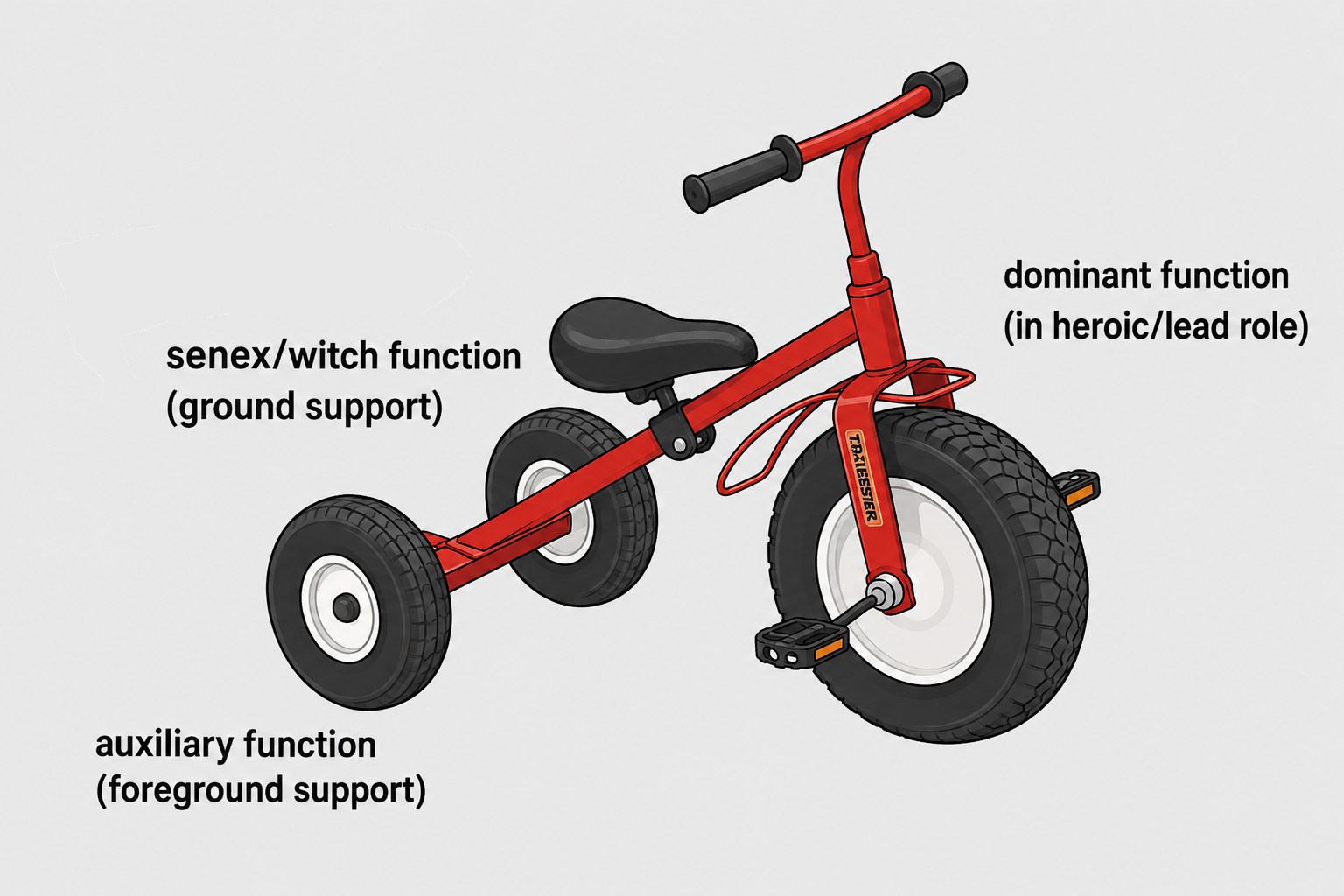
In light of these results from 130,000 people, we might wish to revise the current coding scheme we use to represent personality type patterns. For example, for ISTJ, it is apparently more accurate to say Si-Tx, where Tx indicates both Te and Ti, rather than saying Si-Te. (Thank you Ben Vaserlan for this notation!) It may also be that this configuration develops only with maturity, whereas the traditional notation like Si-Te is appropriate for young people but not for mature adults. Anecdotally, with my INTJ preferences, I remember having to really take notice of Ti in my mid 20s. Further analysis will hopefully clarify this.
Impact: A Revised Stack
There are more results. Of the top four processes, the 4th highest-scoring process was often (33%) the same as the dominant but in the opposite attitude (E.g. Se and Si). The other two-thirds of the time, the picture was rounded out by the process that’s opposite of a support process, such as introverted Feeling (Fi) if the person leads with Sensing and also prefers extraverted Thinking (Te). That’s the traditional 1st, 2nd, 3rd function sequence, which yes, holds two-thirds of the time. Rarely, the 4th was the opposite of the dominant (i.e., Intuiting if Sensing is dominant).
Whatever the specifics for a person, what is normally referred to as the inferior process almost always lies in the bottom half of the hierarchy. This suggests that pairs of functions such as Sensing-Thinking, Sensing-Feeling, Intuiting-Thinking, and Intuiting-Feeling are highly relevant. It also suggests that if we line up a type’s top-four processes, the shadow processes sit between them, not after them, as illustrated here.
Overall, the results support Jung’s and Myers’ notion of dichotomies (processes in opposition). That is, there is a clear pattern where the top two functions score in the top half while their opposites score in the bottom half. For example, if the highest scores are Extraverted Feeling with support from Introverted Intuiting and Extraverted Intuiting, then the bottom half is usually home to low-scorers Sensing and Thinking.
The details vary somewhat for each person. This can be for many reasons, including upbringing, career choice, and the way people interpret the statements or view themselves. Such variations due to “nurture” show up in the data analysis. Statistically, for each dominant cognitive process, we find several latent classes. Each class represents a potential developmental path.
Impact: From 16 to 32 Types?
Typically, we can say there are four classes for each process, suggesting a framework of 32 (8 x 4) patterns is appropriate when talking about development. In my own brain imaging work, I distinguish now between Analytic vs. Holistic versions of each type, typically aligned with a person’s career. This parallels Mina’s analysis.
Based on the results, we posit 3 forces at work, drawing a person to develop:
- The complementary processes (E.g. Ni-Te also develops Ne-Ti)
- The societal modal functions — i.e. introverted Sensing (Si), extraverted Thinking (Te), and extraverted Feeling (Fe)
- The defining functions of their opposite type (e.g. Ni-Te also develops Se-Fi)
To learn about these variants, based on our 2025 analysis, you can find 8 video explainers hosted by Joyce Meng (see References below or hop over to the Resources page on this site).
Impact: Basic vs Advanced Use
The table below summarizes the eight cognitive processes as used in the questionnaire. They are divided into basic and advanced use, which was strongly supported.
Discussions and applications, namely around coaching and profiling, should ideally account for the difference in use. For example, if someone shows a lot of basic use, that does not mean they strongly prefer that process unless they also show advanced use. Or, when coaching someone to improve the use of a process, it is likely best to take a step-wise approach from basic to advanced use. This approach is a fundamental part of the type book, 8 Keys to Self-Leadership.
Perceiving — how we focus our attention and gather information
| Process | Basic Use | Advanced Use |
| Se | Notice sensory data in the environment. | Trust your instincts and take action relevant to the moment and current context. |
| Si | Recall tangible data and experiences. | Stabilize a situation by comparing it to what is expected, known and reliable. |
| Ne | Notice abstract patterns as they emerge. | Shift a situation’s dynamics and explore imaginative potential possibilities. |
| Ni | Receive “ah-ha” insights and realizations. | Pursue a greater level of awareness to transform who you are and how you think. |
Judging — how we organize our experiences and make decisions
|
Process |
Basic Use |
Advanced Use |
|
Te |
Follow steps, points and time tables. |
Create structure, reason by measures and evidence, and implement complex plans. |
|
Ti |
Adhere to definitions and impersonal principles. |
Analyze a problem using a framework, and find an angle or leverage by which to solve it. |
|
Fe |
Honor others’ needs and preferences. |
Connect with people by sharing values and taking on their needs as yours. |
|
Fi |
Adhere to personal beliefs about what’s important. |
Evaluate situations and choose what you believe is congruent with your personal identity. |
Caution: Assessment Bias
With positive results over a huge population, we can use the questionnaire’s statements as a guide to defining the functions. But I say that with a caveat. Every creation holds an imprint of its creator/s. For example, Isabel Myers left an imprint of a slight NP-SJ bias in the MBTI® instrument, which likely follows from her INFP preferences. It took time to iron that out. Similarly, the CPA has a slight bias with some internal correlations between Te-Fi, Te-Ti and Ni-Se, which follow from my INTJ preferences. The bias is slight and does not hinder overall performance but it is something to bear in mind. Happily, Jung intended the functions as a therapeutic framework with definitions that were organic and open-ended rather than logical and limiting. So we are welcome to keep contributing our understanding.
Summary
What does this mean for the type community? There are three big take-aways.
First, we now have strong evidence for a dynamic model of type. If anyone asks, “Where’s the evidence?”, here it is! (And Mina is now working on publishable, peer-reviewed papers.) That said, the dynamic model we found is slightly different in the particulars than the Myers-Briggs model. Those particulars, I think, better describe what many of us have observed for years. So, while some small tweaks are appropriate, they aren’t so surprising.
Second, there is the CPA itself, which can provide a profile of use of the eight processes with attention to basic versus advanced use. And since skillful use of the functions can change over time, we can now track development on a regular basis.
Third, when coaching or otherwise aiming to help someone, it looks like encouraging the so-called 2nd, 3rd, and 6th functions is appropriate, as is some comfort with the 5th and later, the 4th function. I was so swayed by the analysis that, at the last minute, I changed my coaching book, The Magic Diamond, to reflect the Tricycle Model. Hopefully, people can now enjoy a fuller experience around their type.
The 2025 Update
Round 2 of analysis completed in 2025 and includes twice as many subjects and more detailed results. See the Technical Appendix below. In short, round 1 results were confirmed, with a lot more detail around the latent classes that suggest 2 versions (aka subtypes) of each type (which we might call Analytic and Holistic). These two versions cover 85% of persons, on average, leaving 15% of people to fall into a Blended result. We cannot say if these 2 versions are developmental, innate, or something else, since this study is not longitudinal. Until the final paper is published, you can find 8 video explainers hosted by Joyce Meng (see References below or hop over to the Resources page on this site).
References
- Barimany, Mina E. The Hierarchy of Preferences in Jungian Psychological Type: Comparing Theory to Evidence (ProQuest Number 10264427) [Doctoral Dissertation]. The George Washington University. ProQuest Dissertations & Theses Global database, 2017.
- Barimany, Mina E. Evidence for New Dimensions in Type Development. TypeFace , 41. https://apti.memberclicks.net/typeface , Sept., 2020.
- Nardi, Dario. 8 Keys to Self-Leadership: From Awareness to Action . Radiance House, 2005.
- Nardi, Dario. The Magic Diamond: Jung’s 8 Paths for Self-Coaching . Radiance House, 2020.
- Nardi, Dario, with Joyce Meng. Video Explainers: Results of the 2025 CPA Data Analysis . Eight-part video series covering the two main versions of each of the 16 types.
Technical Appendix
Statistical Analysis Methods (Round 2, 2025)
The following details are provided for readers interested in the statistical methods used to examine the assessment’s underlying factor structure and response patterns.
Participants and Data Screening
- The analysis used a secondary sample of people who voluntarily completed the online Interstrength Cognitive Assessment between 2010 and 2018.
- The original database contained 425,896 respondents.
- After applying the exclusion and data-quality criteria, the final sample retained 262,905 participants.
- Because the assessment was openly available online and participants self-selected to take it, exclusion criteria were applied to improve consistency within the sample.
- Participants were excluded when they were younger than 18 or older than 60 years of age.
- Responses completed in languages other than English were excluded.
- Responses containing invalid patterns were excluded, including selecting the same rating for every item or submitting duplicate response patterns.
- A built-in server-side verification system automatically rejected repetitive response patterns, such as assigning the same rating to every item.
- The verification system also rejected idiosyncratic response patterns, including extremely high or extremely low aggregate scores, to reduce non-purposeful submissions and improve data quality.
- Most participants reported that they did not know their own MBTI personality type.
- The reported sex distribution included 127,624 men (48.5%) and 135,281 women (51.5%), for a combined total of 262,905 participants.
Confirmatory Factor Analysis and Cross-Validation
- An exploratory factor analysis using promax rotation and Horn Parallel Analysis identified an underlying eight-factor structure.
- A confirmatory factor analysis (CFA) was then conducted to test whether the same factor structure could be replicated.
- All analyses used a robust maximum likelihood estimator.
- Model fit was evaluated using the Comparative Fit Index (CFI) and the Root Mean Square Error of Approximation (RMSEA).
- Items showing high residual variance or substantial cross-loadings were examined for possible correlated error or exclusion.
- The final item sample produced a CFI of .89, which was treated as satisfactory.
- The final item sample produced an RMSEA of .056, indicating a reasonably close fit to the proposed eight-factor model.
Latent Profile Analysis
- After the sample was finalized, a latent profile analysis was used to identify recurring patterns of responses across participants.
- Model fit was evaluated using the Akaike Information Criterion (AIC), Bayesian Information Criterion (BIC), sample size-adjusted BIC, the BLRT p-value, and entropy.
- Because the sample was unusually large, the sample size-adjusted BIC was treated as the most useful index for judging model fit.
- Final model interpretation used a theory-driven decision approach, following Nylund et al. (2007).