Personality type is most useful when it helps us become less one-sided, more self-aware, and more accepting of human differences.
⭐ Carl Jung approached psychological type as a psychiatrist working with people facing genuine inner conflicts. For Jung, growth meant recognizing our natural preferences without becoming trapped by them—overcoming one-sidedness by developing a healthier relationship with the neglected parts of ourselves.
⭐ Isabel Briggs Myers, author of Gifts Differing, emphasized the value of human differences. Borrowing her title from a Biblical phrase, she hoped type could foster greater understanding and peace while helping people find satisfying work suited to their natural gifts.
⭐ David Keirsey warned against the “Pygmalion project”—our tendency to try to reshape other people in our own image. Type offers an alternative: recognizing that people who differ from us may have equally legitimate ways of perceiving, deciding, communicating, and living.
Other thinkers deepen the picture. Namely, Jungian analyst ⭐
John Beebe explored how cognitive processes interact with archetypal complexes. And ⭐ Linda Berens brought the various traditions together through a living-systems, multiple-model approach. Rather than treating any single model as the whole truth, her work shows how temperament, interaction styles, cognitive processes, archetypes, and type patterns can complement one another to create a richer and more practical understanding of ourselves and others.
An honorable mention: Developmental psychologist ⭐ John Flavell introduced the term metacognition in the 1970s: our ability to think about and monitor our own thinking. Nurturing this ability matters.
Metacognition is not the same as intelligence. A person may be
intellectually bright or highly empathic while having relatively little awareness of how their own psyche operates. IQ, EQ, and self-awareness are related but different capacities.
Ultimately, type is not simply about identifying what kind of person you are. It is a framework for noticing how your mind works, where you become one-sided, and how you can relate more wisely to yourself and to people who think differently.
Theory
In the 1920s, Swiss psychiatrist Carl Jung identified essential mental functions — today known as cognitive processes
Preference
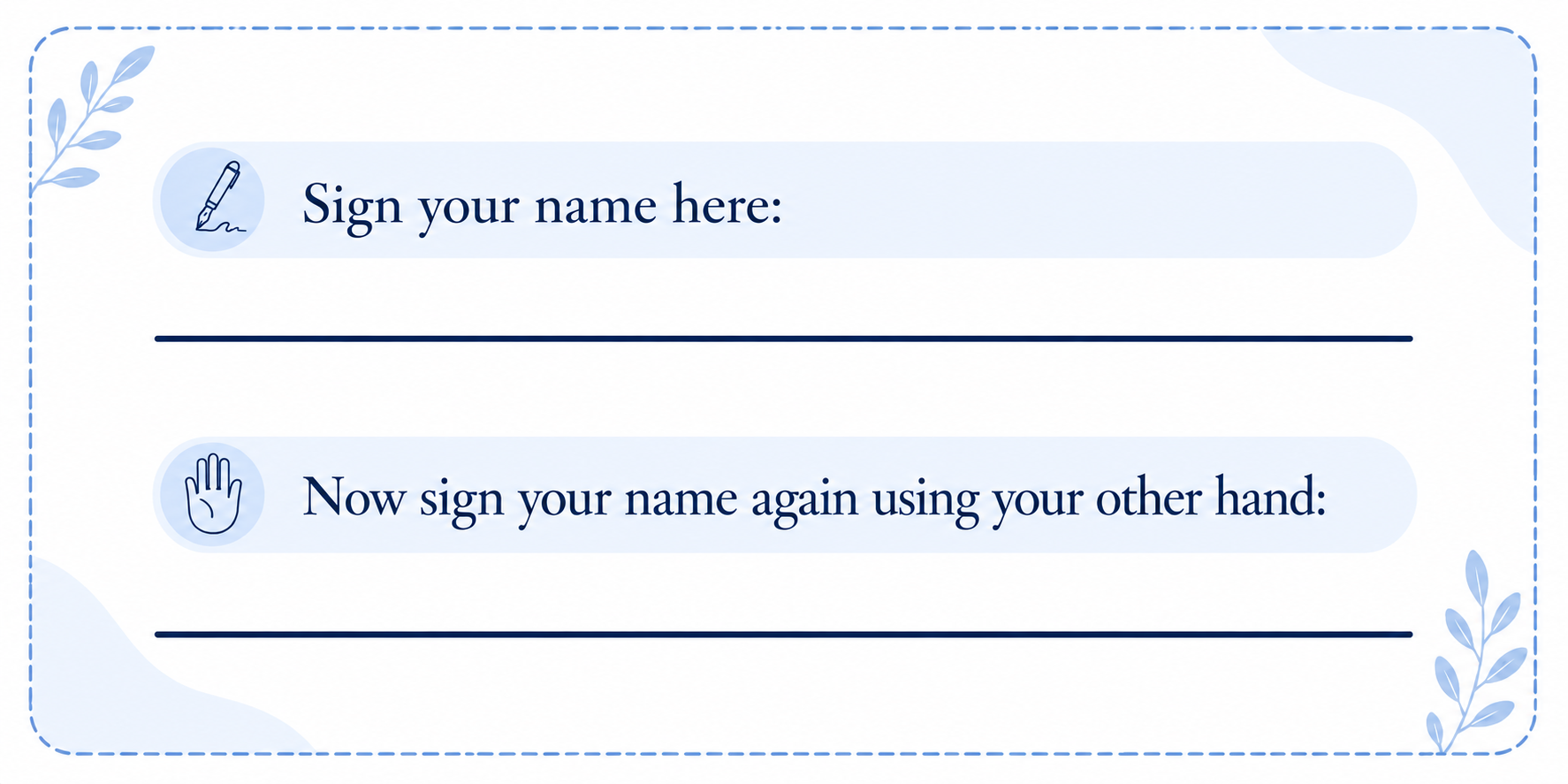
Early on, Jung observed that people tend to be more introverted or extraverted. That is, we get drained and reenergize differently. And, more broadly speaking, he observed that we each have a bias with regard to how we function. As an example, you can try this exercise:
Notice: you can sign your name with either hand. However, using your preferred hand is easier, produces better results, and tends to be automatic.
4 Essentials
Next up, Jung observed that we focus our attention and gather information using Sensing (S) and iNtuiting (N), and we organize our experiences and make decisions using Thinking (T) and Feeling (F). These are technical terms. For example, “feeling” in this context does not mean emotion. It refers to decisions based in values. Everyone uses all four of these in some way, but like handedness, we have preferences, a specialization. Sometimes, a preference can turn into a bias or one-sidedness that is unhealthy. Here's what each of these four looks like when it is over-done. Let's take a look:
Our Two Open-Ended CEOs:
What’s your bias when gathering information?
Sensing (S)
Rely on the five senses first.
Focus on concrete, tangible data and what is known,
the present, and past experiences.
Stay hands-on and act on practical options.
When 1-sided: materialistic, literal-minded,
missing the big picture
Intuiting (N)
Rely on imagination first.
Focus on concepts, patterns, what’s hidden, symbols,
metaphor, and the future.
Ask “what if?” Follow potential possibilities.
When 1-sided: ungrounded, overly abstract,
pie in the sky
Our Two Goal-Focused CEOs:
What’s your bias when organizing and making decisions?
Thinking (T)
Rely on logic first. Decide and organize based on
objective criteria, deduction, models, frameworks,
measures, and impersonal, efficient principles.
When 1-sided: critical, stiff and robotic,
inhumane
Feeling (F)
Rely on values first. Decide and organize based on
social and interpersonal appropriateness, beliefs,
and the importance or worth of oneself and others.
When 1-sided: melodramatic, hopelessly
idealistic, needy
Notice that Sensing, iNtuiting, Thinking, and Feeling are verbs. They are not trait words (adjectives) like outgoing, open-minded, friendly, conscientious or neurotic. Instead, these reflect how we work "under the hood". We use these processes to metabolize our environment, to direct our attention, make decisions, and so on.
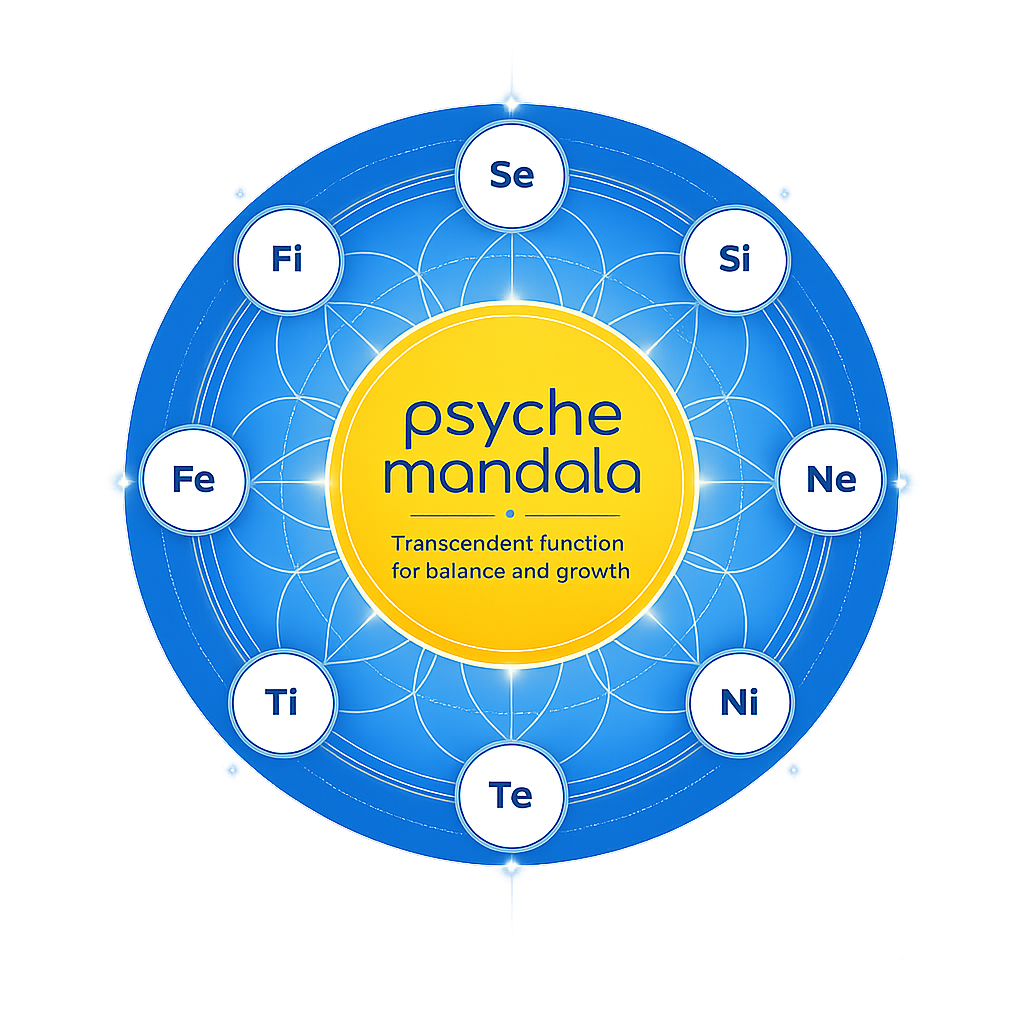
In Psychological Types, Jung brought together his main observations. He described how each of these four processes plays out in a person’s “internal world” (I) of thoughts, feelings, memories and imagination; and in the “external world” (E) of actions, people, tools, and organizations. Thus, there are eight cognitive processes (Se, Si, Ne, Ni, Te, Ti, Fe, Fi). Within each ous, these eight work together as part of a pattern of balances and polarities, akin to handedness. Jung's concepts — 8 processes, plus related concepts like polarities, and basic vs. advanced use (below) — are validated through the assessment at this site, based on analysis of 260,000 respondents.
Basic and Advanced Use
Each of the 8 cognitive process can be engaged in a basic, unsophisticated way reflecting our natural human capabilities. Almost everyone can engage each process in some basic way. Beyond this, you will engage some cognitive processes in a more sophisticated, developed way. This is usually the result of innate preference plus lifelong growth and practice, which equals development.
Perceiving — how we focus attention and gather information
Cognitive Process
Basic (Passive) Use
Advanced (Active) Use
extraverted Sensing (Se)
Notice sensory data in the environment.
Trust your instincts and take action relevant to the moment and current context.
introverted Sensing (Si)
Recall tangible data and experiences.
Stabilize a situation by comparing it to what is expected, known and reliable.
extraverted Intuiting (Ne)
Notice abstract patterns as they emerge.
Shift a situation’s dynamics and explore imaginative potential possibilities.
introverted Intuiting (Ni)
Receive “ah-ha” insights and realizations.
Pursue a greater level of awareness to transform who you are and how you think.
Judging — how we organize experiences and make decisions
Cognitive Process
Basic (Passive) Use
Advanced (Active) Use
extraverted Thinking (Te)
Follow steps, points and time tables.
Create structure, reason by measures and evidence, and implement complex plans.
introverted Thinking (Ti)
Adhere to definitions and impersonal principles.
Analyze a problem using a framework, and find an angle or leverage by which to solve it.
extraverted Feeling (Fe)
Honor others’ needs and preferences.
Connect with people by sharing values and taking on their needs as yours.
introverted Feeling (Fi)
Adhere to personal beliefs about what’s important.
Evaluate situations and choose what you believe is congruent with your personal identity.
According to Jung, development is more than basic or advanced use of processes in isolation. Excellent use of a cognitive process involves both basic and advanced use as appropriate, and ability to deploy other processes in its service. Average to good use usually means we can use the process in limited situations or use it well but only with the aid of other processes. Poor use means basic use at most. Finally, we may get ourselves into trouble when we don’t use a process at all. Jung advocated that we can engage in activities that may help us develop; ultimately, however, development is driven by unconscious processes, the sum of which Jung referred to as the Transcendent function (see last section below).
Exploring the Eight Processes
Here are in-depth descriptions of the eight cognitive processes. They are adapted from Linda V. Berens and Dario Nardi, Understanding Yourself and Others: An Introduction to the Personality Type Code (Telos Publications, 2004) and used with permission.
Se – Extroverted Sensing → acts in the moment ← Extraverted Sensing occurs when we become aware of what is in the physical world in rich detail. We may be drawn to act on what we experience to get an immediate result. We notice relevant facts and occurrences in a sea of data and experiences, learning all the facts we can about the immediate context or area of focus and what goes on in that context. An active seeking of more and more input to get the whole picture may occur until all sources of input have been exhausted or something else captures our attention. Extraverted Sensing is operating when we freely follow exciting physical impulses or instincts as they come up and enjoy the thrill of action in the present moment. A oneness with the physical world and a total absorption may exist as we move, touch, and sense what is around us. The process involves instantly reading cues to see how far we can go in a situation and still get the impact we want or respond to the situation with presence.
Si – Introverted Sensing → draws on past experience ← Introverted Sensing often involves storing data and information, then comparing and contrasting the current situation with similar ones. The immediate experience or words are instantly linked with the prior experiences, and we register a similarity or a difference — for example, noticing that some food doesn’t taste the same or is saltier than it usually is. Introverted Sensing is also operating when we see someone who reminds us of someone else. Sometimes a feeling associated with the recalled image comes into our awareness along with the information itself. Then the image can be so strong, our body responds as if reliving the experience. The process also involves reviewing the past to draw on the lessons of history, hindsight, and experience. With introverted Sensing, there is often great attention to detail and getting a clear picture of goals and objectives and what is to happen. There can be a oneness with ageless customs that help sustain civilization and culture and protect what is known and long-lasting, even while what is reliable changes.
Ne – Extroverted Intuiting → generates new ideas ← Extraverted iNtuiting involves noticing hidden meanings and interpreting them, often entertaining a wealth of possible interpretations from just one idea or interpreting what someone’s behavior really means. It also involves seeing things “as if”, with various possible representations of reality. Using this process, we can juggle many different ideas, thoughts, beliefs, and meanings in our mind at once with the possibility that they are all true. This is like weaving themes and threads together. We don’t know the weave until a thought thread appears or is drawn out in the interaction of thoughts, often brought in from other contexts. Thus a strategy or concept often emerges from the here-and-now interactions, not appearing as a whole beforehand. Using this process we can really appreciate brainstorming and trust what emerges, enjoying imaginative play with scenarios and combining possibilities, using a kind of cross-contextual thinking. Extraverted iNtuiting also can involve catalyzing people and extemporaneously shaping situations, spreading an atmosphere of change through emergent leadership.
Ni – Introverted Intuiting → envisions the future ← Introverted iNtuiting involves synthesizing the seemingly paradoxical or contradictory, which takes understanding to a new level. Using this process, we can have moments when completely new, unimagined realizations come to us. A disengagement from interactions in the room occurs, followed by a sudden “Aha!” or “That’s it!” The sense of the future and the realizations that come from introverted iNtuiting have a sureness and an imperative quality that seem to demand action and help us stay focused on fulfilling our vision or dream of how things will be in the future. Using this process, we might rely on a focal device or symbolic action to predict, enlighten, or transform. We could find ourselves laying out how the future will unfold based on unseen trends and telling signs. This process can involve working out complex concepts or systems of thinking or conceiving of symbolic or novel ways to understand things that are universal. It can lead to creating transcendent experiences or solutions.
Te – Extroverted Thinking → gets things done efficiently ← Contingency planning, scheduling, and quantifying utilize the process of extraverted Thinking. Extraverted Thinking helps us organize our environment and ideas through charts, tables, graphs, flow charts, outlines, and so on. At its most sophisticated, this process is about organizing and monitoring people and things to work efficiently and productively. Empirical thinking is at the core of extraverted Thinking when we challenge someone’s ideas based on the logic of the facts in front of us or lay out reasonable explanations for decisions or conclusions made, often trying to establish order in someone else’s thought process. In written or verbal communication, extraverted Thinking helps us easily follow someone else’s logic, sequence, or organization. It also helps us notice when something is missing, like when someone says he or she is going to talk about four topics and talks about only three. In general, it allows us to compartmentalize many aspects of our lives so we can do what is necessary to accomplish our objectives.
Ti – Introverted Thinking → clarifies and defines ← Introverted Thinking often involves finding just the right word to clearly express an idea concisely, crisply, and to the point. Using introverted Thinking is like having an internal sense of the essential qualities of something, noticing the fine distinctions that make it what it is and then naming it. It also involves an internal reasoning process of deriving subcategories of classes and sub-principles of general principles. These can then be used in problem solving, analysis, and refining of a product or an idea. This process is evidenced in behaviors like taking things or ideas apart to figure out how they work. The analysis involves looking at different sides of an issue and seeing where there is inconsistency. In so doing, we search for a “leverage point” that will fix problems with the least amount of effort or damage to the system. We engage in this process when we notice logical inconsistencies between statements and frameworks, using a model to evaluate the likely accuracy of what’s observed.
Fe – Extroverted Feeling → responds to others' needs ← The process of extraverted Feeling often involves a desire to connect with (or disconnect from) others and is often evidenced by expressions of warmth (or displeasure) and self-disclosure. The social graces such as being polite, being nice, being friendly, being considerate, and being appropriate, often revolve around the process of extraverted Feeling. Keeping in touch, laughing at jokes when others laugh, and trying to get people to act kindly to each other also involve extraverted Feeling. Using this process, we respond according to expressed or even unexpressed wants and needs of others. We may ask people what they want or need or self-disclose to prompt them to talk more about themselves. This often sparks conversation and lets us know more about them so we can better adjust our behavior to them. Often with this process, we feel pulled to be responsible and take care of others’ feelings, sometimes to the point of not separating our feelings from theirs. We may recognize and adhere to shared values, feelings, and social norms to get along.
Fi – Introverted Feeling → stays true to oneself ← It is often hard to assign words to the values used to make introverted Feeling judgments since they are often associated with images, feeling tones, and gut reactions more than words. As a cognitive process, it often serves as a filter for information that matches what is valued, wanted, or worth believing in. There can be a continual weighing of the situational worth or importance of everything and a patient balancing of the core issues of peace and conflict in life’s situations. We engage in the process of introverted Feeling when a value is compromised and we think, “Sometimes, some things just have to be said.” On the other hand, most of the time this process works in private and is expressed through actions. It helps us know when people are being fake or insincere or if they are basically good. It is like having an internal sense of the essence of a person or a project and reading fine distinctions among feeling tones.
Sixteen Thematic Patterns
Jung observed that everyone has potential access to all eight cognitive processes but that we each prefer one as dominant — playing a lead role — with a second process playing a support role. Your two preferred cognitive processes allow you to do information gathering and decision making, introverting and extraverting. Maybe you prefer introverted Intuiting in a lead role with extraverted Feeling in a support role (coded as Ni • Fe), or maybe you prefer extraverted Sensing in a lead role with introverted Thinking in a support role (coded as Se • Ti). Or maybe you prefer some other pairing. These pairings tap into sixteen possible thematic patterns that are often represented using a 4-letter code (such as "INFJ" or "ESTP").
The 4-Letter Myers-Briggs Code
One way to name our profile is the Myers-Briggs 4-letter code. The code looks like ESTJ, INFP, or such. In the code, the letters stand for preferences that work like handedness. The code was developed by Isabel Myers and Katherine Briggs in the 1940s, and it is widely used throughout the world today. Let’s take a look.
Understanding the four letters of a personality type
1
1st letter: Where you find energy
E—Extraverting
Initiate interactions and energized by collaborative activities.
I—Introverting
Focus on inner life and energized by solitary activities.
2
2nd letter: How you take in information
S—Sensing
Focus on what’s tangible, known, concrete, practical for today,
and fits experience.
N—iNtuiting
Focus on abstractions, patterns, potential possibilities,
imagination, and the future.
3
3rd letter: How you make decisions
T—Thinking
Organize and decide based on objective, impersonal criteria.
F—Feeling
Organize and decide based on harmony, values, and beliefs.
4
4th letter: How you like to organize
J—Judging
Look and plan ahead with a drive for completion and closure.
P—Perceiving
Open and engaged with a drive for more input and flexibility.
The first three letters clearly parallel Jung's framework. But what about the 4th letter Judging or Perceiving ? It tells us which process faces the world. That is, if we prefer
Judging (J): We use Thinking (T) or Feeling (F) to deal with the world.
Perceiving (P): We use Sensing (S) or iNtuiting (N) to deal with the world.
Many people know about the 16 types through this coding. However, the codes are pretty limited. They present a static picture. In contrast, the original thinker behind this framework, Dr. Carl Gustav Jung, intended a dynamic picture of human beings. To honor that aim, we remember to go deeper and pay attention to the underlying cognitive processes.
Now, here are the sixteen type patterns, each with a name, 4-letter code, and its preferred cognitive processes.
Themes of the 16 Type Patterns
FORESEER DEVELOPER™
INFJ — Ni • Fe
INFJs focus on personal growth. They have a talent for foreseeing. A flash of insight comes and they know what will happen. They can sustain a vision while honoring the gifts of others. They need a sense of purpose and take a creative approach to life. INFJs can get into exploring issues to bridge differences and connect people and ideas. They can get analytical when problem solving. Living an idealistic life often presents them with a great deal of stress and a need to withdraw.
HARMONIZER CLARIFIER™
INFP — Fi • Ne
INFPs need a quest or core meaning. Yet they tend to go with the flow. They have a talent to listen in order to help, noticing what sits behind what’s said. They explore moral questions, enjoy uncovering mysteries, and relate through stories and metaphors. INFPs have a way of knowing what is believable. They seek to balance opposites. To get to really know oneself again is a beautiful moment. They can manage others pretty well. They struggle with structure and getting their lives in order.
PLANNER INSPECTOR™
ISTJ — Si • Te
ISTJs like to be prepared and draw up plans. They take responsibility as best they can. They get work done first, are active in the community, and loyal to their roles. Doing the right thing is important to them. Every day they strive to cultivate good habits. ISTJs bear life’s burdens and cross bridges of adversity. They have a talent to plan, sequence, fill in details, and note what’s missing. They have a sense of history and a subtle sense of humor. Learning so much in hindsight pains them at times.
PROTECTOR SUPPORTER™
ISFJ — Si • Fe
ISFJs notice what’s needed and valuable. They have a talent for arrang- ing careful support. They enjoy their traditions and work to protect the future. They often listen closely to remember a lot of details. They tend to be agreeable. They are sensitive to the small things, with strong preferenc- es. When appropriate, ISFJs like to volunteer. They like to feel a sense of accomplishment. They can get technical, knowing all of the ins and outs. They get frustrated when people ignore rules and don’t get along.
ENVISIONER MENTOR™
ENFJ — Fe • Ni
ENFJs like to communicate and share values. They set goals and seek shared success. They strive to realize dreams—their own and others. They look for ways to grow together. They heed the call to a life’s work or mission. They have a talent for noticing potential in others. ENFJs enjoy being creative, using their intuitive intellect. They try to bridge the past and the future. When needed, they can get very precise or technical. They find it hard to live in the present moment, to feel at peace.
DISCOVERER ADVOCATE™
ENFP — Ne • Fi
ENFPs explore perceptions and try out stories. They often see what’s hidden and voice what’s really meant. They notice others’ potential and like to inspire. They ask what-if and fly with creative new ideas. They want goodness and happiness. ENFPs strive to honestly believe in and live with themselves. They have a talent to bring about ideal or magical mo- ments with someone. When needed, they can organize and manage a lot. They often feel restless with a hunger to discover their true direction.
IMPLEMENTOR SUPERVISOR™
ESTJ — Te • Si
ESTJs strive to bring order to chaotic situations. They have an indus- trious, hard-work attitude. They quickly educate themselves and connect the dots. When needed, they step up to supervise. They rely on a philos- ophy of life and seek the steps to success. ESTJs like to keep up traditions and reflect on life’s wealth of experiences. They value being well balanced. To reveal a person’s character, they can get sharp. They can feel let down when their standards for economy and quality are not met.
FACILITATOR CARETAKER™
ESFJ — Fe • Si
ESFJs easily accept and help others. They are often managing people. They hear out others, voice concerns, and accommodate needs. They eas- ily keep in mind what’s personally important, and they have a talent to provide what’s needed. ESFJs admire others’ success. They strive to keep things pleasant. They keep up a sense of continuity. They account for the human costs. They can surprise others, act as a rebel, or get inventive. They can easily feel let down by entrepreneurial projects.
CONCEPTUALIZER DIRECTOR™
INTJ — Ni • Te
INTJs are abstract, self-directed thinkers. They have a drive for self-mas- tery to make the most of what they can achieve. They have a talent to calculate far ahead and see deep reasons behind things. They think in terms of concepts, evidence, efficiency, systems, and strategies. INTJs build a vision and take steps to realize progress to their goals. They like to stay indepen- dent and are invariably at the leading edge. Their secret is creative flow. They can find it hard to let go to interact freely with others.
DESIGNER THEORIZER™
INTP — Ti • Ne
INTPs like to explore ideas to deepen their expertise. They notice new patterns and elegant connections. They easily cross boundaries of thought. They play with ideas and detach to analyze. They clarify, refer- ence, and define. INTPs have a talent to design and redesign. They are open to try whatever starts up their imagination. They like to reflect on thinking. They hold to core principles and solid models. Making discov- eries brings them joy. They struggle to attend to the physical world.
ANALYZER OPERATOR™
ISTP — Ti • Se
ISTPs are hands-on problem solvers. They closely observe how things work. They will carefully take apart or poke at something to understand it. They have a talent for using tools to take the best approach to a prob- lem. ISTPs need to be independent to follow their own paths. They like to test, challenge, and push their own limits to find success. They act on their hunches or intuitions. Making and sharing their own discoveries is satisfying. Powerful emotional experiences can really unsettle them.
COMPOSER PRODUCER™
ISFP — Fi • Se
ISFPs seek life’s pulse to go with its flow. They are patient to take advantage of opportunities as they come up naturally. They stick with what’s important, to be their true selves with their own personal style. They have a talent for pulling together what feels just right for an artistic impact. ISFPs attract others’ loyalty and build relationships with care. They like to play against expectations and can get really creative at solv- ing a problem. They struggle to nurture their self-esteem.
STRATEGIST MOBILIZER™
ENTJ — Te • Ni
ENTJs easily act as leaders with a vision. They bring in resources of all kinds and maximize talents to make the most progress. They can predict what’s coming up in the big picture. They enjoy intuitive explorations and can buck convention. Where they can, ENTJs forge partnerships, mentor, and empower others. Often, they find they are running many projects. They know peace and conflict go together. They have a soft spot. They can get overwhelmed managing a lot of details of time and resources.
EXPLORER INVENTOR™
ENTP — Ne • Ti
ENTPs are inventive and life-long learners. They explore lots of ideas. They have a talent to build prototypes and launch projects. They enjoy creative problem solving and like to share their insights about life’s pos- sibilities. ENTPs are pragmatic as they come up with strategies for suc- cess. They enjoy the drama of give and take. They try to be diplomatic, invite others, and host. At some level, they need to feel safe. They are surprised when strategizing a relationship doesn’t work.
PROMOTER EXECUTOR™
ESTP — Se • Ti
ESTPs smoothly get on top of things. They are tactical and quickly play off of the relevant details. They set a priority while staying open to options. They enjoy exhilaration at the edge. They have a talent for negotiating and can win over people to get a lot done through others. ESTPs want a bottom-line measure of their success. They enjoy acting as a consultant. They have a deep, heart-felt care for their family and friends. They are disappointed when others don’t show respect.
MOTIVATOR PRESENTER™
ESFP — Se • Fi
ESFPs are active and fun. They easily engage others. They have a sense of style and a talent to present things in a useful way. They look for ways to motivate and stimulate action, to take pleasure in life. They enjoy learning about people. ESFPs like their freedom and are open to taking risks. They are adaptable, charming, and enjoy opening others to what they can do. In their heart, they care deeply. Many kinds of tasks come naturally to them. Over-analyzing situations can trouble them.
Personality Type as a Map for Development
Each type is a compass to help us grow with meaning and balance.
At the heart of Jung's work is the Transcendent function. It is the urge and wisdom within us to keep growing in various ways large and small. It is the bridge between past, current, and future versions of ourselves. And engaging it helps rebalance our lives. This is why Jung's ideas are a compass to growth (or therapy), rather than a simple game of who prefers which processes.
Personality as a Mandala
A great metaphor for growth is the mandala, a geometric symbol. It asks us to focus and also be open-minded. The term originates in ancient India, but as Jung noted, the Christian cross is also a mandala. Like a monk contemplating a mandala in order to gain insights, days and years in-and-out, we can keep returning to Jung's framework of eight cognitive processes for insight.
Type as a Pattern
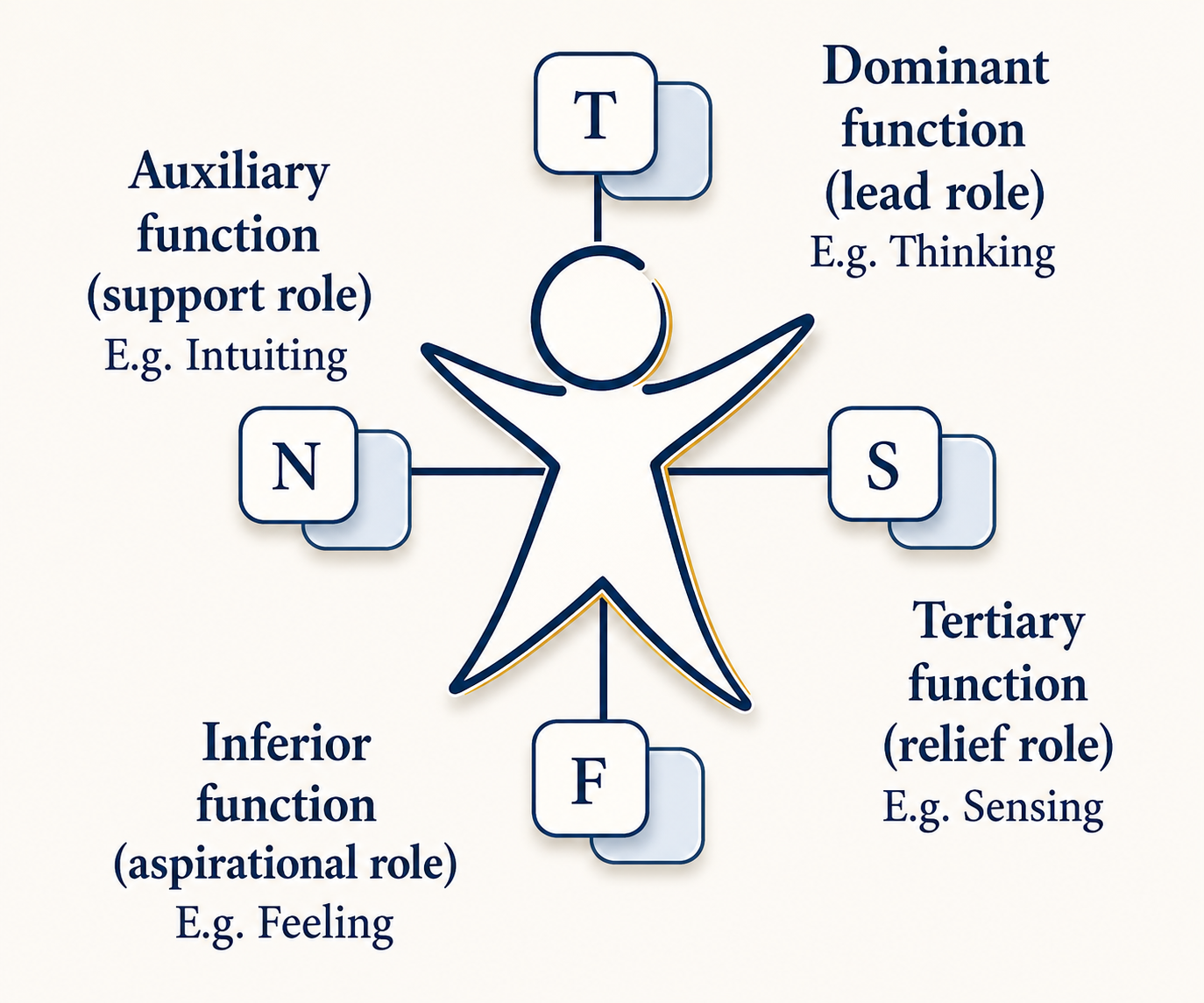
Jung viewed the psyche as organized through polarities: conscious and unconscious, ego and shadow, Thinking and Feeling, Sensing and iNtuiting, and so on. For example, among the 8 processes, Te and Fi are classic opposites, as are Se and Ni. Each of the 16 types is in fact a pattern of polarities, often shown like this:
In this figure, Thinking (at the head) is the dominant (lead/heroic) process, with iNtuiting (the right hand) as an auxiliary (support) process. But having a head and a hand are not enough. Feeling (at the left hand) is our tertiary process, while Sensing (at the feet) is our inferior process. It's a system: the two hands often work together, and the feet walk the body to where the head sees to go.
Integration of Opposites
Whatever the polarity, growth does not come from defeating one side or forcing a bland compromise. It comes from holding the tension between opposites long enough for a new and more inclusive perspective to emerge. He called this the transcendent function—a process through which neglected qualities are brought into relationship with our usual strengths, creating greater balance, flexibility, and psychological wholeness. The table below, drawn from The Magic Diamond, illustrates how each preferred process can mature by integrating something valuable from its opposite.
Integration of Opposites
Wiser Judgment
Keener Perception
Timely Builders (Te)
care with their best formulas
(add Fi)
Active Adapters (Se)
act with inner genius
(add Ni)
Quiet Crusaders (Fi)
objectively validate their cause
(add Te)
Keen Foreseers (Ni)
travel their secret path
(add Se)
Friendly Hosts (Fe)
follow objective human principles
(add Ti)
Excited Brainstormers (Ne)
settle in their magical place
(add Si)
Skillful Sleuths (Ti)
analyze with compassion
(add Fe)
Cautious Protectors (Si)
stand by the change
(add Ne)
Yin/Yang Expression
Besides the mandala and stick figure, another metaphor to help us understand personality is the yin-yang symbol: ☯️. The yin-yang symbol, or taijitu, is a circular sign split by a curved line into equal black and white swirling halves, each containing a small dot of the opposite color. It visually represents ancient Chinese philosophical concepts where opposite, complementary forces interact to maintain balance and harmony in the universe.
Just as conscious ego and unconscious shadow are like yang and yin, so too does each cognitive process, within itself, have both yin and yang sides. These are like two sides of the same coin, or like sun and moon, or man and woman. Besides yin and yang, some people call these holistic and analytic, or masculine and feminine, though these are slightly different ideas. Brain imaging data, as described in Decode Your Personality, supports the existence of yin and yang for each function and for each of the 16 types as well.
Analytic and Holistic Styles
Each cognitive process can appear in a more focused, directed
Analytic style or a more receptive, contextual Holistic style.
These are complementary approaches rather than better and worse
ways of thinking.
Analytic / Yang (🎯)
Active, focused, and relatively fixed. This style emphasizes
the foreground subject, explicit goals, and top-down direction.
Holistic / Yin (🌐)
Receptive, diffuse, and flexible. This style emphasizes
background context, relationships, and bottom-up emergence.
Cognitive processes
Analytic / Yang
Holistic / Yin
Sensing and Intuiting
Focus on the central figure, object, or issue rather than
the surrounding context. Attention is directed toward what
is most immediately relevant.
For example, while driving, attention may go primarily
to signs and obstacles directly related to the journey.
Focus on the wider setting, background, and context rather
than only the obvious central figure. Attention spreads
across the whole situation.
For example, while watching a play, attention may include
the full experience—front and back, onstage and offstage.
Thinking and Feeling
Take a more deliberate, defined, and mentally organized
approach. Thinking applies strict criteria,
definitions, measurement, and analysis.
Feeling follows explicit values, principles,
or ideals and may set goals or issue a call to action.
Take a looser, more organic, and relational approach.
Feeling attends to the full web of emotions,
values, relationships, and social cues.
Thinking holds several models or methods
lightly and allows them to complement one another.
You can explore the yin/yang sides of all 8 cognitive processes here.
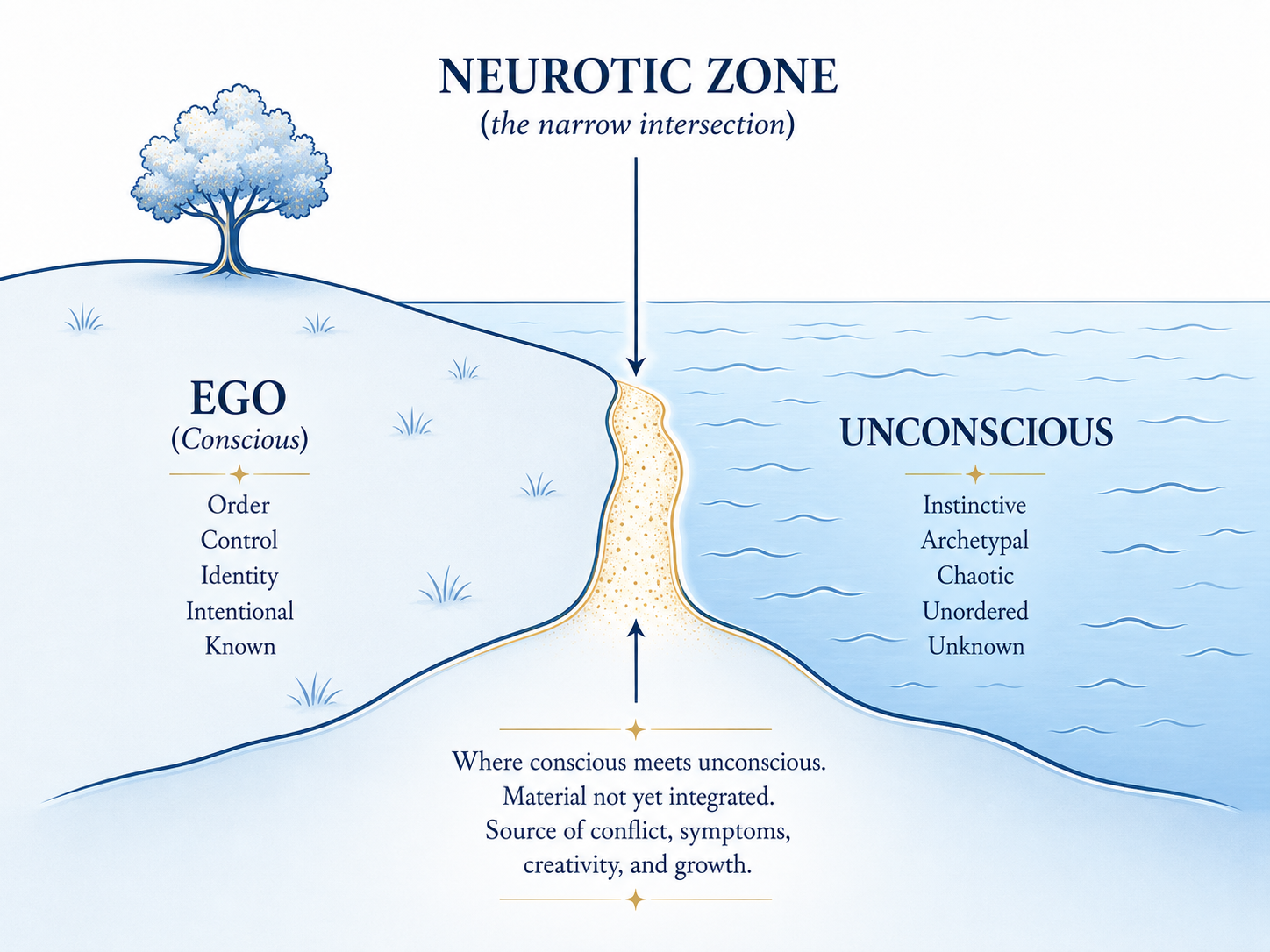
The Neurotic Zone
Walk along a beach, or between farm and forest, and you will notice something interesting. Many times, the richest, most interesting areas of life are the boundaries between two areas, two ways of living. Similarly, when we take a walk along the boundary between our ego and our unconscious self (such as we can), we will encounter a lot of interesting... challenges. This boundary is our neurotic zone. Everyone has one, no matter how well managed. And typically, this zone is filled with various challenges related to our type. These challenges are an annoyance, but they are also what allow us to grow.
Typically, this zone is home to our tertiary (third) function. Each of the 16 types, and indeed every person, has a different neurotic zone. And we use your type as a map to understand and manage its contents.
You can look here at the neurotic zone for all 16 types. Also, here on Youtube is a video explainer with Joyce Meng.
Psyche as a Living System
At times, some people can get overly excited or rigid around the use of the Jungian and Myers-Briggs framework. They may forget that the word personality contains the word person and is always and everywhere about people. And people are not math models, logics, or stories. People are living systems: organic and complex, with metabolism and environment. Consider this tree across seasons:
The figure above reminds us of key points. I order to thrive, the tree requires water, sun, soil, and suitable temperature. Moreover, tree remains a tree, and the kind of tree it is, regardless of change. Yet with changes in environment, the expression of the tree does change over time. It may be barren, fruitful, or so forth. The tree also has a lifecycle, from seed to sapling to adult. Although people are more complex in various ways, a tree is a very suitable metaphor to understand the psyche.
This is why the Cognitive Processes Assessment here focus on a profile of the eight processes. Each process is assessed independently. This allows every person to be unique, reflecting unique circumstances while keeping a general framework in mind.
Further Exploration
Here are some resources in hardcopy and e-book format to further understand your profile and the framework in general: